
which METHY-SEQ workflow?
Not all methyl-seq workflows are built the same — and we scientists can be dedicated to our favorite workflow.
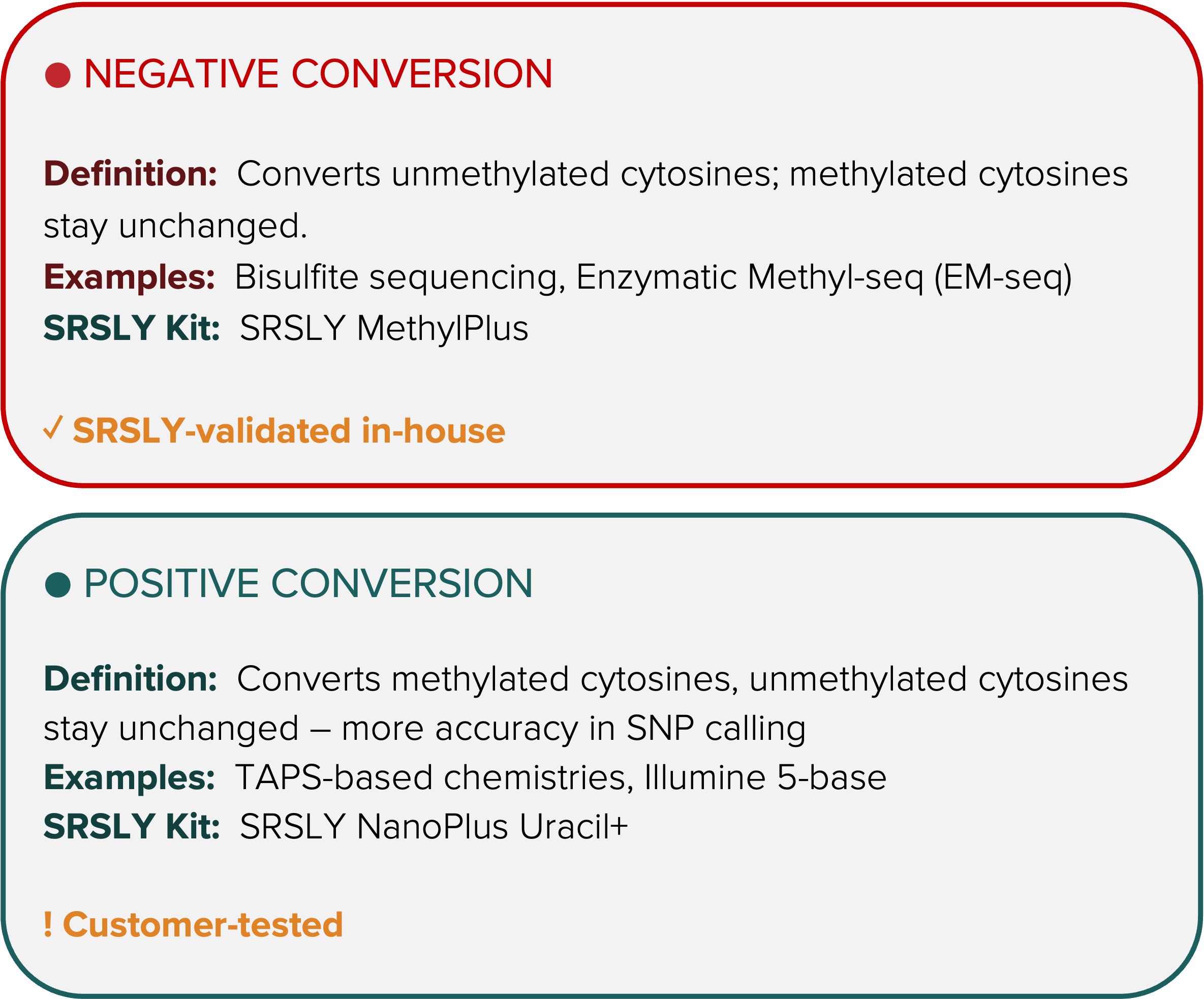
The right combination of methyl-conversion method and SRSLY library prep depends on input type: gDNA or cfDNA, downstream application: methylation alone, methylation with targeted enrichment of differentially methylated regions and SNPs or methylation with fragmentomics or multimodal analyses capturing everything!
SRSLY® MethylPlus (and SRSLY®) bring real advantages to your methyl-seq experiments — but when and how you convert within the library is not just a detail, it’s a decision. Convert without understanding the biases at play, and your data pays the price.
Use the selector tool below to find the methyl-seq workflow - conversion and library prep combination that best fits your input and application. Read along for a deeper dive.
srsly, agnostic
One workflow. Any conversion path — SRSLY adapts whichever way you convert, upstream or downstream, positive or negative.
SRSLY, let’s get into it
Still got questions? We've broken down the most common use cases below — expand the one that matches your workflow to see our recommendation.
-
For combined methylation and fragmentomics, SRSLY enables preservation of native fragment ends by performing adapter ligation before methyl conversion (“downstream conversion”). This workflow retains native termini while enabling methylation analysis. In these applications, gentler conversion chemistries—such as NEBNext EM-seq V2 or TAPS+—are recommended to minimize damage to the ligated library and maximize template fidelity.
-
For standard methylation profiling, both enzymatic and bisulfite conversion methods are compatible. Even when conversion further shortens cfDNA fragments, the SRSLY library efficiently captures these smaller molecules. If targeted enrichment follows, however, hybrid capture workflows and probe design should be optimized to accommodate the shorter fragment distribution.
-
Methylation profiling — with or without targeted enrichment — is the predominant application of Methyl-Seq. Bisulfite conversion remains a common choice for methyl-conversion chemistry, and SRSLY's ForShear enzymatic fragmentation module generates sequencer-compatible fragment sizes downstream of conversion, with minimal DNA loss despite conversion-induced degradation. From there, a standard hybrid-capture protocol can be layered on to enrich for the regions or variants of interest.
SRSLY MethylPlus for methylation and fragmentomics
LITERATURE AND RESOURCES
Want to go deeper? Explore the brochure, citations and webinars below for the data, chemistry details, and use cases behind SRSLY's methylation and fragmentomics workflows.
LITERATURE
VIDEOS AND TALKS
PUBLICATIONS
Download our latest paper on the SRSLY MethylPlus workflow
CITED WORKs
Visit our Citations page to reads all publications from our users who have applied SRSLY and MethylPlus adapters to their Methyl-Seq workflows.
Write to us at info@claretbio.com general enquiries.